
• Latest
  • Trending
  • All
Answer card: a static site wins on speed and security, WordPress wins on convenience for non-technical editors; the deciding question is who edits the site.

WordPress vs a static site: which to run in 2026

3 September 2026
Answer card for Claude Opus 5.5: 4 dollars in and 20 dollars out per million tokens, down from 5 and 25, with cache reads at 20 cents.

Claude Opus 5.5 drops to $4 and $20, and breaks four Opus 5 habits

23 September 2026
The official xAI announcement card for Grok 4.7, white type on a dark grey and navy gradient.

Grok 4.7 keeps $2 and $6, and its gains over 4.6 are xhigh versus high

22 September 2026
Answer card stating that Qwen-Image-2.1, released on 20 September 2026, ships open weights with a 7 billion parameter diffusion transformer, a Qwen3-VL 8B text encoder and an RGBA VAE totalling about 33 gigabytes in BF16, under the Qwen Research License that limits use to research or evaluation and requires a separate commercial licence, unlike the Apache 2.0 licence of Qwen-Image 1.0.

Qwen-Image-2.1 brings the weights back, but not the Apache licence

21 September 2026
Answer card stating that Ternary Bonsai 2 27B, released by PrismML on 17 September 2026 under Apache 2.0, packs Qwen3.8 27B into 5.95 gigabytes at 1.72 bits per weight, keeps 98.2 percent of the 14-benchmark average, about 75 percent on SWE-bench Verified and Terminal-Bench 2.1, and needs PrismML's llama.cpp fork to run.

Does Bonsai 2 27B really keep 98% of Qwen3.8 in 5.95 GB?

20 September 2026
Answer card stating that Jev 1.13 from TypeSafe AI is a decision model in early access since 15 September 2026 that returns typed probabilities instead of text, priced at 42 dollars per billion input tokens with output tokens free, answering in 70 to 500 milliseconds, with a 64K token request budget, text input only, and a documented list of things it does badly, including counting and dates.

Jev 1.13 bills $42 a billion tokens, and it can’t count

19 September 2026
Answer card stating that Qwen3.8-Omni-Flash launched on 17 September 2026 as an API only model on Alibaba Cloud Model Studio, taking text, images, audio and video in a 1M token context and returning text only, priced at 0.15 dollars per million input tokens for every modality and 0.47 dollars per million output tokens in the international regions, with no open weights published and the Qwen-Live Harness GitHub repository returning 404.

Qwen3.8-Omni-Flash bills audio at $0.15 and ships no weights

18 September 2026
Answer card stating that on 15 September 2026 AWS said it is unable to restore access to resources and data hosted exclusively in the Middle East Bahrain region me-south-1 and in the mec1-az2 zone of the UAE region, because the damage spanned multiple Availability Zones and exceeded what multi-AZ services are designed to withstand.

AWS can’t restore me-south-1, six months after the drone strikes

17 September 2026
Answer card stating that Google released Gemini 3.8 Live and Gemini 3.8 Live Extended Thinking on 15 September 2026 at 3 dollars per million audio input tokens and 12 dollars out, that the thinking model requires asynchronous tools, and that Artificial Analysis scores it 82.6 on its Speech to Speech Quality Index.

Gemini 3.8 Live Extended Thinking rejects any tool that blocks

16 September 2026
Answer card summarising the Atria Dawn Preview release: 744B GLM-5.2 base, MIT licence, 1.5 TB BF16 and 756 GB FP8 checkpoints, 256K context, top on five of sixteen benchmark rows and trailing on SWE-bench Pro.

Atria Dawn Preview is 744B under MIT, and the BF16 weighs 1.5 TB

15 September 2026
Answer card stating that OpenAI released the Agents API in public beta on 10 September 2026 with no separate fee, billed through model tokens, tool calls and hosted sandbox time, with a choice of OpenAI hosted, self hosted or partner sandboxes, US only data residency and no Zero Data Retention support.

OpenAI’s Agents API has no fee, no ZDR and a one hour sandbox clock

14 September 2026
Answer card: Sakana Fugu Max at $2 and $6 per million tokens, Fugu Ultra v2 unchanged at $5 and $30, and Sakana saying Ultra v2 scores without Fable 5 or GPT-6 Astra in its pool.

Fugu Max costs $2 and $6 while Fugu Ultra v2 runs without Fable 5

13 September 2026
Answer card stating that DeepSeek released DeepSeek-V4.1-Flash on 10 September 2026 as a 552 billion parameter mixture of experts model with a new causal encoder decoder architecture that activates 8 billion parameters on input and 16 billion on output, with native vision, a one million token context and MIT licensed weights, that the API model name is now deepseek-flash at 0.15 dollars per million input tokens and 0.60 dollars per million output tokens off peak, and that DeepSeek announced V4 Pro would be routed to V4.1-Flash from 14 September and reversed that on 11 September.

DeepSeek V4.1-Flash arrived, and the V4 Pro retirement lasted a day

12 September 2026
  • About
  • Contact
  • Privacy
  • Legal
Thursday, September 24, 2026
  • Login
Packet Nebula
  • Home
  • Articles
    • Security
    • Network
    • Dev
    • Sysadmin
    • SEO
    • Email & DNS
  • Tools
    • Network tools: free, fast, no signup
    • Security tools: free, fast, no signup
    • Developer tools: free, fast, no signup
    • Sysadmin tools: free, fast, no signup
    • SEO tools: free, fast, no signup
    • Email & DNS tools: free, fast, no signup
  • Download
  • About
No Result
View All Result
Packet Nebula
No Result
View All Result
Home SEO

WordPress vs a static site: which to run in 2026

by stephane
3 September 2026
in SEO
0
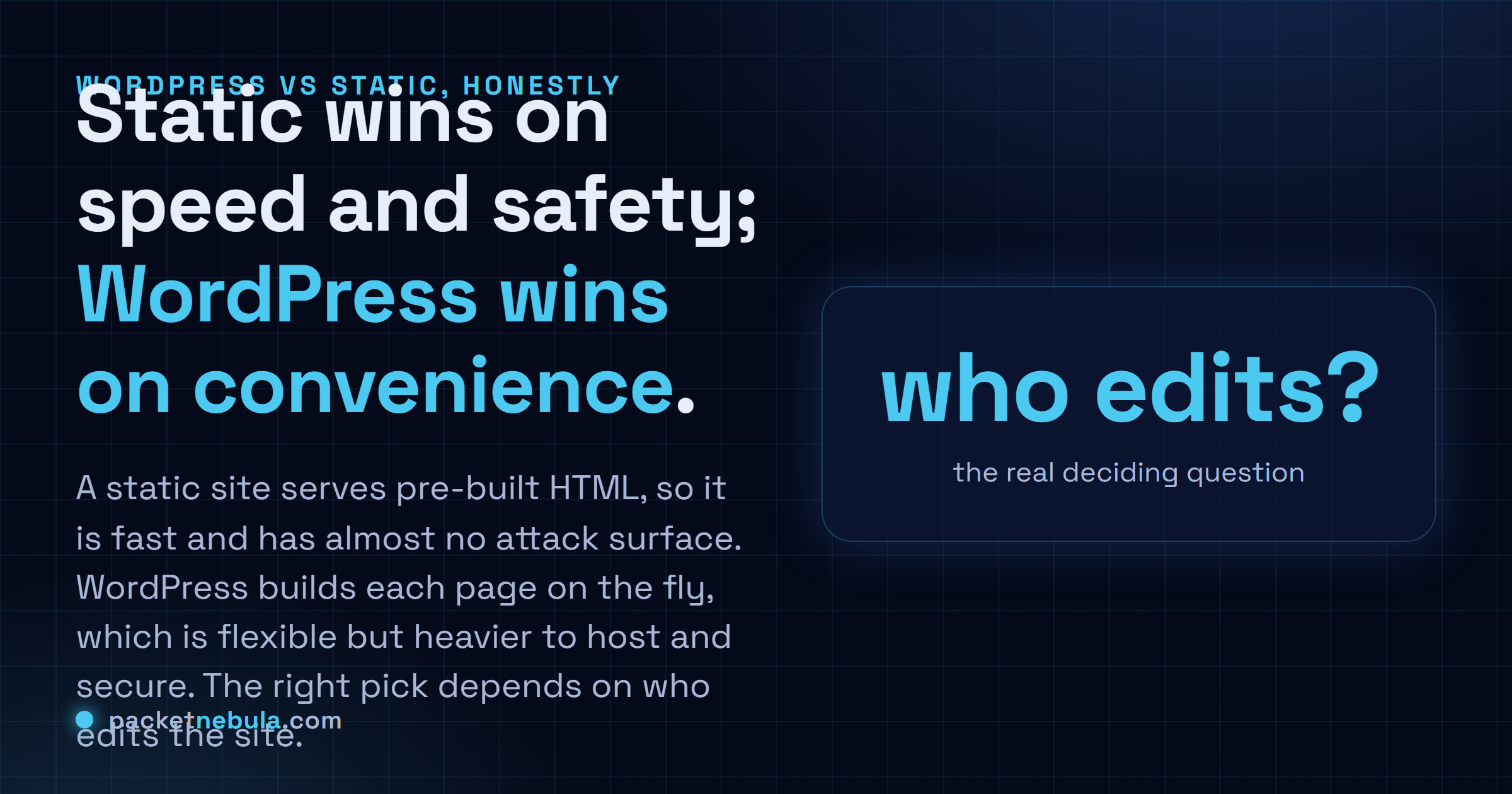
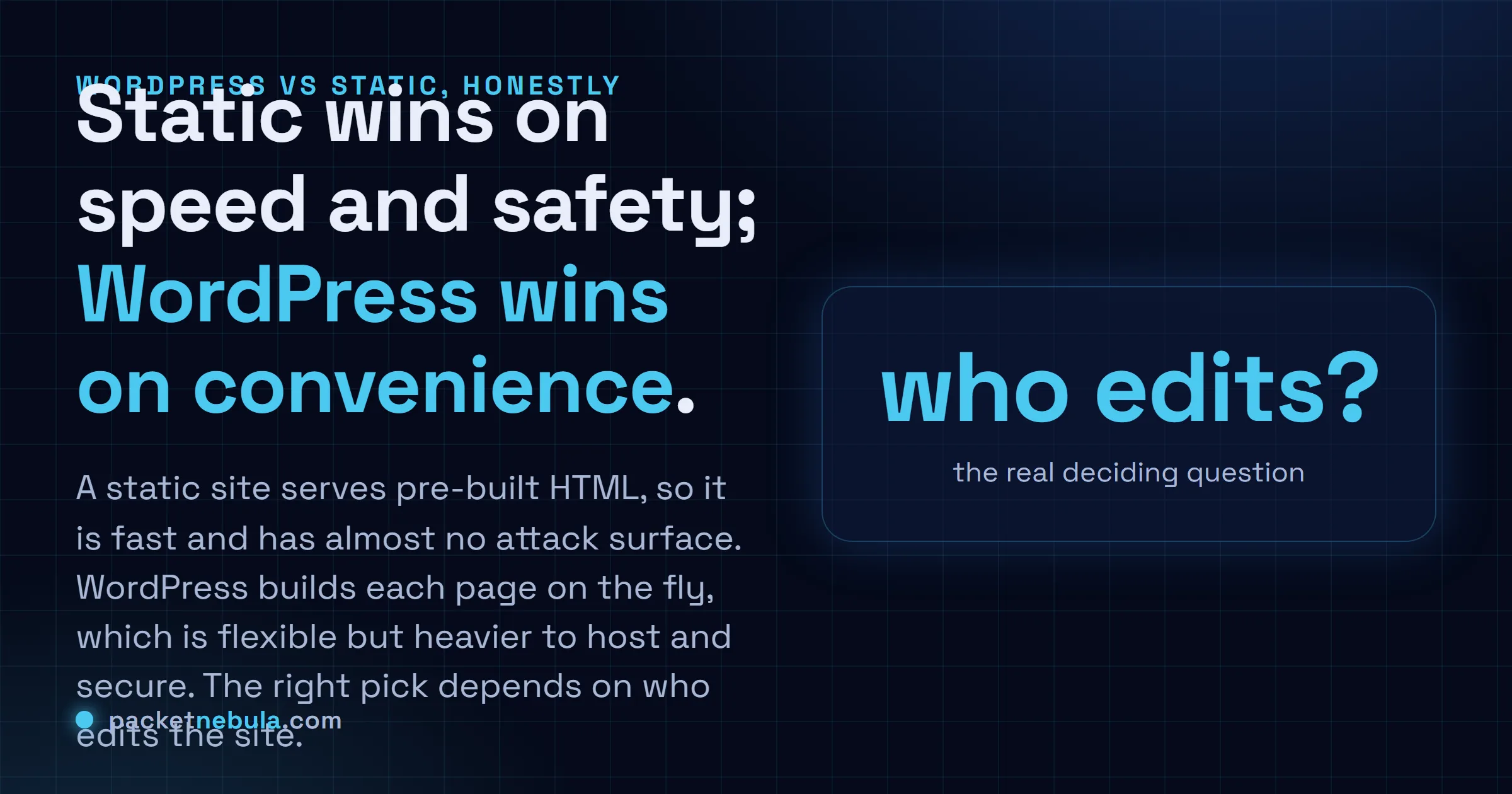
Answer card: a static site wins on speed and security, WordPress wins on convenience for non-technical editors; the deciding question is who edits the site.
494
SHARES
1.4k
VIEWS
Share on FacebookShare on Twitter

So you're starting a site, and everyone you ask has already picked a side. Here's the honest answer: it's a trade-off, and it hangs on one question, who edits the site and how often. Static ships plain HTML that was built ahead of time. Fast, cheap to host. Barely anything on it to attack. WordPress builds each page on the spot from PHP and a database, which is genuinely great if you're not technical and just want to log in and write, but it's heavier to host and slower out of the box until you bolt on caching. We've run both for years and there's no tribe to defend here, just where the speed gap really comes from and how to choose for your own project instead of the loudest opinion online.

The short answer

Static sites serve HTML that’s already built: fast and cheap, with barely anything to hack. WordPress assembles each page live from PHP and a database, lovely for non-coders but heavier to host and secure. Honestly, the choice comes down to who edits the site, not to which one is “better”.
Staticfaster, safer, cheaper
WordPresseasier for non-coders
who edits?the deciding question
Answer card stating static wins on speed and security while WordPress wins on convenience, with who-edits-the-site as the deciding question.
No universal winner. The trade-off is real, and it has a deciding question.

Most takes on this pick a side and dig in. Wrong instinct. WordPress runs a huge chunk of the web because people who don’t write code need to publish, a lot, without filing a ticket with a developer every time. Static sites are having their moment because, for a different kind of project, they’re faster and cost almost nothing to keep alive. Both things are true at once. The only question worth asking is which kind of project you’ve actually got.

Speed: why static starts ahead

The gap isn’t WordPress being sloppy. It’s structural, and this picture is basically the whole argument:
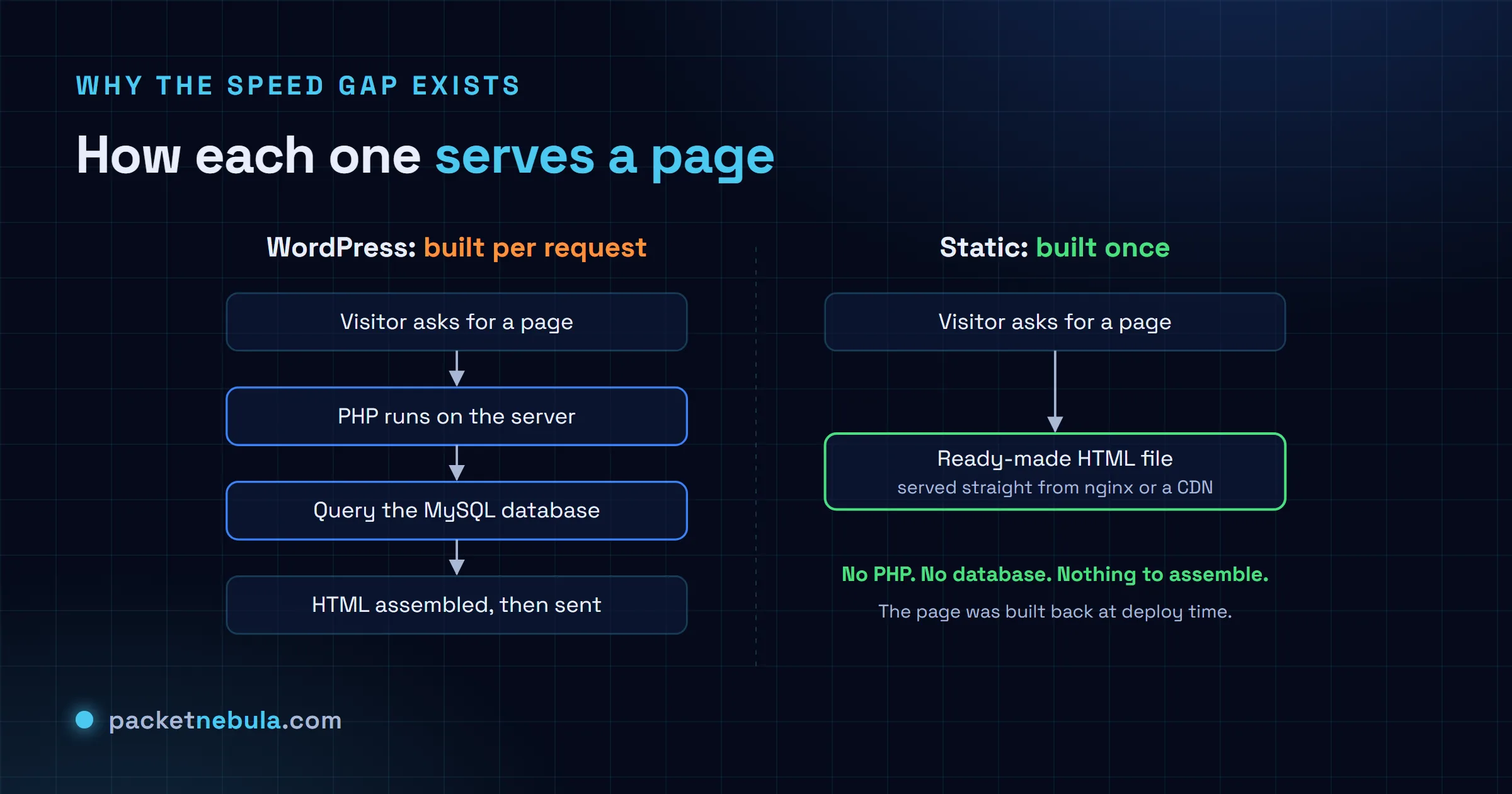
Diagram comparing how WordPress builds a page per request through PHP and MySQL, versus a static site serving a ready-made HTML file from nginx or a CDN.
Same page, two paths. One gets assembled on every visit; the other already exists.

Ask WordPress for a page and the server has to wake up. PHP spins up, MySQL gets queried, the HTML gets stitched together, and only then does anything reach the visitor. A static site skips all of that. The HTML was built once, at deploy time, and the server just hands over the file it already has. That shows up first as time to first byte, then carries straight through into the Core Web Vitals Google actually grades you on.

Caching muddies it, sure. A good WordPress cache plugin stores the finished page and serves the copy, which gets you most of the way to static. Right up until a plugin update or a logged-in request busts the cache and PHP wakes up all over again. The static site never has that bad afternoon. One speed, the fast one, all day.

Want it concrete? We ran both kinds of page through GTmetrix from the same test location. A plugin-heavy WordPress page came back a C: 66% performance and a 3.2s Largest Contentful Paint. A static page (this one, in fact) came back an A: 93% performance and a 1.3s LCP. Blocking time: zero. Same job, very different numbers.


GTmetrix report band for a plugin-heavy WordPress page: grade C, 66% performance, 89% structure, 3.2s Largest Contentful Paint, 149ms Total Blocking Time, 0.03 Cumulative Layout Shift.
Plugin-heavy WordPress: GTmetrix grade C, 66% performance, 3.2s LCP. A real report.
GTmetrix report band for a static page: grade A, 93% performance, 98% structure, 1.3s Largest Contentful Paint, 0ms Total Blocking Time, 0 Cumulative Layout Shift.
This static site: GTmetrix grade A, 93% performance, 1.3s LCP. Same test, same server.
MetricPlugin-heavy WordPressStatic site (this one)
GTmetrix gradeCA
Performance66%93%
Largest Contentful Paint3.2s1.3s
Total Blocking Time149ms0ms
Cumulative Layout Shift0.030

Security and cost: the surface you babysit

A WordPress install is a lot of moving code. The core and the theme, plus every plugin you’ve ever added, all running on the server and touching a database. Each one is somewhere a vulnerability can live, and honestly, the plugin ecosystem is where most real break-ins start, usually through something nobody got around to updating. Keeping it locked down is a recurring chore.

A static site barely gives an attacker anything to hold onto. There’s no database to inject into and no PHP to trick. The login form attackers love to hammer? Not there. The server hands out files and that’s the end of it. Doesn’t make it magic, you still harden the host and the build pipeline, but a whole genre of the attacks that hammer WordPress just finds nothing to work with here.

Static is cheap, sometimes free outright. Prebuilt files happily sit on a CDN or a static host for nothing, or take up a sliver of a small VPS where one box serves several static sites without breaking a sweat. WordPress wants more: PHP and MySQL running around the clock, which is exactly why the cheapest shared hosting feels like wading through treacle. A setup that doesn’t feel slow costs more per month than the static equivalent. You’re paying to keep that per-request machinery warm whether anyone visits or not.

Upkeep, and the honest downside of going static

This is where the day-to-day really splits. WordPress needs maintenance you can’t skip: core and plugin updates land constantly, and letting them pile up is how a perfectly nice site quietly turns into a liability. Leave it a few months and you’re choosing between a nervy bulk update and a hole you already know about.

Static flips that around. Nothing’s running in production to patch. You bump dependencies on your own schedule, on your own machine, and a broken build blows up on your laptop instead of taking the live site down with it. The work moved from small chores forever to a build step when you publish. I know which one I’d rather own.

Editing. That’s the catch, and it’s a real one. With WordPress, a non-technical author logs in and types into a familiar box. Publish, done. With a plain static site, publishing means editing files and running a build, which suits a developer far more than a marketing person trying to fix a typo before lunch. There’s a middle ground, a headless CMS: writers get a proper editor and the output stays static. But it bolts back on some of the moving parts you went static to escape. Three non-technical people updating the site every week? Think hard before you migrate. I’ve watched that exact mismatch make everyone miserable.

So, which one?

Who edits it. Genuinely, that’s the deciding question, not which tech is having a moment. If the content changes on a schedule rather than by the hour, and a build step doesn’t faze whoever keeps the site running, go static. A blog, docs, a brochure site, a tools site like this one, all happy there. WordPress earns its keep the day non-technical people need to publish daily, or you actually depend on a plugin for a shop or memberships. Then the convenience is worth the overhead, no shame in that. Match the tool to the people who’ll touch it and most of the speed-versus-security argument stops mattering. (Sizing up a host either way? Our HTTP headers checker grades what a site already sends back, one click.)

Frequently asked questions

Is a static site always faster than WordPress?

By default, yeah, and for a structural reason: a static server just hands over a file that already exists, while WordPress runs PHP and hits a database to build the page first. Heavy caching narrows the gap a lot, but the static site starts ahead and stays there. No plugins quietly dragging it down, either.

Is WordPress insecure?

Not on its own. It just has a far bigger attack surface: the core and the theme are code running on your server, and so is every single plugin, and all of it needs patching. A static site has no database and no server-side code to exploit, so a whole class of attacks finds nothing to grab. You can secure WordPress well. It's just ongoing work.

Can non-technical people edit a static site?

That's the catch. Editing means changing files and running a build, which suits a developer way more than a marketing team that wants to fix a typo at 5pm. A headless CMS gives writers a proper editor that still outputs static pages, but it adds back some of the complexity you left WordPress to escape.

So when does WordPress actually win?

When non-technical people publish often, or when you genuinely need plugins for a shop or memberships. A team where a build step would just never happen counts too. For a blog, docs, a brochure site, or a tools site that changes on a schedule, static is usually the better home.

Tags: articlehostingperformancestatic-sitewordpress
Share198Tweet124
stephane

stephane

  • Trending
  • Comments
  • Latest
Answer card: Proton Lumo 2.0 is private by policy, not by locality. Saved history is locked so even Proton cannot read it, but the prompt is decrypted on a Proton EU server to answer it, then forgotten.

Proton Lumo 2.0 review: how private is it, really?

3 September 2026
The Agentic Coding section of the official Hy4 preview benchmark appendix published by Tencent, a table comparing Hy3 and Hy4 preview against DeepSeek V4 Pro 0813, Qwen 3.8 Max, GLM 5.3, Kimi K3, GPT 5.6 Sol and Claude Opus 5 across SWE-bench Multilingual, SWE-bench Pro, DeepSWE, three SWE Atlas tasks, SWE-Marathon, Terminal-Bench 2.1, NL2Repo-Bench, CyberGym, ProgramBench, PostTrainBench and Harbor-Index.

Tencent’s 770B Hy4 tops one benchmark row in 46

3 September 2026
Answer card: Qwen 3.7 Max is API-only and cannot run locally yet; the open Qwen models (Qwen 3.6 27B, qwen3:8b to 32b) run offline via Ollama.

Qwen 3.7 local: what you can actually run offline

22 June 2026
Answer card: JWTs are not encrypted, anyone can read them; the signature proves who issued the token, not who may read it.

Are JWTs encrypted? No, and the difference will bite you

0
Answer card: a random 8 character password falls in under 2 hours offline, while 16 random characters hold for 1.4 trillion years at the same speed.

How long does it take to crack a password in 2026?

0
Answer card: three DNS records decide if your mail lands or bounces; SPF lists allowed senders, DKIM signs messages, DMARC sets the failure policy.

SPF, DKIM and DMARC explained: the records your email needs

0
Answer card for Claude Opus 5.5: 4 dollars in and 20 dollars out per million tokens, down from 5 and 25, with cache reads at 20 cents.

Claude Opus 5.5 drops to $4 and $20, and breaks four Opus 5 habits

23 September 2026
The official xAI announcement card for Grok 4.7, white type on a dark grey and navy gradient.

Grok 4.7 keeps $2 and $6, and its gains over 4.6 are xhigh versus high

22 September 2026
Answer card stating that Qwen-Image-2.1, released on 20 September 2026, ships open weights with a 7 billion parameter diffusion transformer, a Qwen3-VL 8B text encoder and an RGBA VAE totalling about 33 gigabytes in BF16, under the Qwen Research License that limits use to research or evaluation and requires a separate commercial licence, unlike the Apache 2.0 licence of Qwen-Image 1.0.

Qwen-Image-2.1 brings the weights back, but not the Apache licence

21 September 2026
  • About
  • Contact
  • Privacy
  • Legal

Copyright © 2026 Stephane Cardon.

Welcome Back!

Login to your account below

Forgotten Password?

Retrieve your password

Please enter your username or email address to reset your password.

Log In
No Result
View All Result
  • Home
  • Articles
    • Security
    • Network
    • Dev
    • Sysadmin
    • SEO
    • Email & DNS
  • Tools
    • Network tools: free, fast, no signup
    • Security tools: free, fast, no signup
    • Developer tools: free, fast, no signup
    • Sysadmin tools: free, fast, no signup
    • SEO tools: free, fast, no signup
    • Email & DNS tools: free, fast, no signup
  • Download
  • About

Copyright © 2026 Stephane Cardon.